


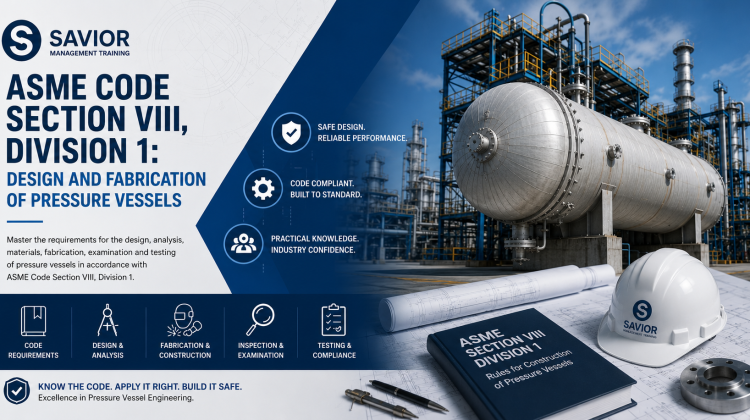
ASME Code Section VIII, Division 1: Design and Fabrication of Pressure Vessels
3-Day Live Online Training Course
Dates: 1–3 July 2026
Master ASME Section VIII Division 1 Pressure Vessel Design, Fabrication & Inspection
Advance your engineering expertise with this comprehensive ASME Section VIII Division 1 Pressure Vessel Design and Fabrication Training Course. Designed for engineers, inspectors, fabricators, quality professionals, and maintenance personnel, this live virtual course provides practical knowledge of the internationally recognised ASME Boiler and Pressure Vessel Code (BPVC).
Participants will gain a thorough understanding of the requirements for designing, manufacturing, inspecting, testing, and documenting pressure vessels operating under internal or external pressure exceeding 15 psig, while ensuring compliance with ASME standards and industry best practices.
Delivered by an experienced industry expert in a fully interactive online classroom, this course combines live instruction, practical examples, real-world case studies, and hands-on calculations to help participants confidently apply ASME Code requirements in the workplace.
Course Overview
The ASME Boiler and Pressure Vessel Code (BPVC) Section VIII, Division 1 establishes internationally accepted rules for the design, fabrication, inspection, testing, certification, and quality assurance of pressure vessels used across industries such as oil and gas, petrochemical, mining, power generation, manufacturing, water treatment, food processing, pharmaceuticals, and chemical processing.
Understanding these requirements is essential for ensuring equipment safety, regulatory compliance, operational reliability, and cost-effective pressure vessel design.
This intensive three-day online course provides a practical introduction to the complete pressure vessel lifecycle, including:
- Pressure vessel design principles
- Material selection
- Welding and fabrication requirements
- Heat treatment
- Non-destructive testing (NDT)
- Hydrostatic and pneumatic pressure testing
- Quality assurance
- Documentation and ASME stamping
- Introduction to API 510 Pressure Vessel Inspection
Participants will learn how to interpret ASME Code requirements, perform design calculations, understand fabrication standards, and prepare compliant engineering documentation.
Learning Outcomes
After completing this course, participants will be able to:
- Understand the structure and purpose of the ASME Boiler and Pressure Vessel Code
- Apply ASME Section VIII Division 1 requirements to pressure vessel design
- Interpret Code rules for fabrication and construction
- Select appropriate materials for pressure vessel applications
- Understand welding categories and joint efficiencies
- Perform pressure vessel design calculations
- Apply Design-by-Rule methodologies
- Understand Appendix 46 and Division 2 design references
- Evaluate heat treatment requirements
- Understand Non-Destructive Testing (RT, UT, MT and PT)
- Perform pressure testing in accordance with ASME requirements
- Prepare Manufacturer’s Data Reports and Code documentation
- Understand ASME Code stamping requirements
- Apply API 510 inspection principles
- Improve safety, compliance, reliability, and operational performance
Who Should Attend?
This course is ideal for:
- Mechanical Engineers
- Design Engineers
- Pressure Vessel Engineers
- Project Engineers
- Plant Engineers
- Process Engineers
- Maintenance Engineers
- Reliability Engineers
- Mechanical Technicians
- Pressure Vessel Fabricators
- Welding Engineers
- Welding Inspectors
- Quality Assurance Professionals
- NDT Personnel
- Inspection Engineers
- API Inspectors
- Procurement Engineers
- Asset Integrity Engineers
- Plant Managers
- Maintenance Managers
- Government Inspectors
- Regulatory Authorities
- Anyone involved in pressure vessel design, fabrication, inspection or maintenance
Previous pressure vessel experience is beneficial but not essential. Both beginners and experienced professionals will benefit from this practical course.
Course Outline
Day 1 – Introduction & Fundamentals of ASME Section VIII Division 1
Module 1 – Introduction
- Course objectives
- Overview of ASME BPVC
- Pressure vessel applications
- International compliance requirements
Module 2 – ASME Boiler & Pressure Vessel Code
- History and development
- Purpose of the Code
- Scope of Section VIII Division 1
- Jurisdictional requirements
Module 3 – Certificates of Authorization
- Qualification requirements
- Manufacturer responsibilities
- Authorization process
- Code certification
Module 4 – Code Structure
- Organization of Section VIII
- Code navigation
- Definitions
- Mandatory and non-mandatory requirements
Module 5 – Pressure Vessel Design Fundamentals
- Joint categories
- Weld efficiencies
- Static head
- Design pressure
- Design temperature
- Radiographic examination
- RT factors
- Basic design calculations
- Reference charts
Module 6 – Practical Case Study
- Applying ASME VIII-1 design requirements
Day 2 – Materials & Fabrication
Module 7 – Material Requirements
- Material specifications
- Material selection
- Traceability
- Identification
- Material testing
Module 8 – Fabrication Requirements
- Fabrication sequence
- Forming operations
- Welding procedures
- Inspection requirements
- Traceability
Module 9 – Heat Treatment
- Post Weld Heat Treatment (PWHT)
- Heat treatment methods
- ASME Code requirements
Module 10 – Advanced Fabrication Topics
- Recent Code updates
- Best practices
- Industry applications
Module 11 – Practical Fabrication Case Study
- Material selection
- Fabrication planning
- Compliance verification
Day 3 – Testing, Inspection & Quality Assurance
Module 12 – Non-Destructive Testing (NDT)
- Radiographic Testing (RT)
- Ultrasonic Testing (UT)
- Magnetic Particle Testing (MT)
- Liquid Penetrant Testing (PT)
- Personnel qualification
- Acceptance criteria
Module 13 – Pressure Testing
- Hydrostatic testing
- Pneumatic testing
- Safety precautions
- Minimum Design Metal Temperature (MDMT)
Module 14 – Documentation & ASME Stamping
- Manufacturer’s Data Reports
- Quality records
- Compliance documentation
- ASME nameplates and stamping
Module 15 – API 510 Pressure Vessel Inspection
- API 510 overview
- Inspection planning
- Inspection intervals
- Fitness-for-service concepts
- Risk-based inspection principles
Module 16 – Practical Case Study
- Turnaround planning
- Inspection strategy
- Pressure vessel lifecycle management
Meet Your Presenter
Denzil Bazley
Denzil Bazley is a registered Professional Engineer and holder of the Government Certificate of Competency (GCC Mechanical) with more than 30 years of engineering, maintenance, and industrial management experience.
His experience spans the petrochemical, oil and gas, FMCG, manufacturing, water, wastewater, and heavy industrial sectors across more than ten countries.
His specialist expertise includes:
- Pressure Vessel Engineering
- Boiler Operations
- Maintenance Management
- Shutdown & Turnaround Planning
- Project Management
- Mechanical Engineering
- Asset Management
- Safety Management
- Production Management
- Change Management
His practical industry knowledge provides participants with valuable real-world insights that extend beyond the Code requirements.
Why Attend This Course?
By attending this course, you will:
- Gain practical knowledge of ASME Section VIII Division 1
- Improve pressure vessel design competency
- Understand fabrication and welding requirements
- Learn inspection and testing procedures
- Reduce compliance risks
- Improve equipment reliability
- Enhance workplace safety
- Strengthen your engineering credentials
- Apply internationally recognised ASME standards with confidence
Course Details
Course: ASME Code Section VIII, Division 1 – Design and Fabrication of Pressure Vessels
Dates: 1–3 July 2026
Duration: 3 Days
Delivery: Live Online Training
Contact: +27 87 265 2274
Email: info@saviortraining.co.za
